
 ASOCIACION CULTURAL CRISTOBAL COLON
SEARCHING FOR THE TRUTH...
The Asociación Cultural Cristóbal Colón (Christopher Columbus Cultural Association) presents the Permanent Exhibition
entitled “Cristóbal Colom y Mallorca” (Christopher Columbus and Mallorca).
The Christopher Columbus Cultural Association, based in Palma de Mallorca was founded in Madrid in 1963 by The Honourable Don Cristóbal Colón de Carvajal y Maroto, Duke of Veragua, a direct
descendant of the Discoverer, has been undertaking extensive work in Spain and America, in the form of conferences, talks and in particular the publication of some interesting articles on Christopher
Columbus.
One of the key goals of the Association is to gain a deeper insight into the admiral’s personality and to promote the research studies aimed at proving that he was born in Felanitx (Mallorca) in
1460. He was the illegitimate son of Charles, Prince of Viana (the brother of King Ferdinand the Catholic) and his mother was the Mallorcan Margalida Colom.
Those collaborating on our cultural project include Don Cristóbal Colón de Carvajal y Gorosábel, the son of the Association’s founder and its Honorary President, and Don José María Segovia Azcárate,
President of Real Sociedad Colombina Onubense (Royal Columbus Society of Huelva).
The permanent exhibition “Cristóbal Colom y Mallorca” dedicated to the explorer will feature, among other items, various books, manuscripts, documents, reproductions of Mallorcan nautical charts,
maps of the period and also several facsimiles of letters from Columbus, which are normally kept in the General Archives of the Indies and Simancas.
Indeed, the accounts handed down by word of mouth from our ancestors who lived in the towns in the central part of Mallorca have maintained since the Age of Discovery that Christopher Columbus was
born in Felanitx.
However, since that memorable date of 12 October 1492, until the present day, many theories have been formulated on the origins of the Discoverer.
The obscurity surrounding his origins has led historians to render their own extremely diverse interpretations and there are numerous claims with regard to the Admiral’s place of birth.
The theory regarding his Mallorcan heritage had not been substantiated by documentary evidence prior to the last century, when various historians endeavoured to prove that the true Discoverer of
America was not the Genoese Crisóforo Colombo, but rather the Mallorcan Cristóbal Colom.
The first of these was certainly the Peruvian Luis Ulloa, who dedicated his life to the subject from 1922 onwards, resigning from his post as Director of the National Library of Lima when he was
assigned a special mission by the Government of Peru to carry out research in the Archives and Libraries of Europe.
Ulloa, in a book published in 1927, “Cristòfor Colom, fou Català, la veritable gènesi del descobriment (Christopher Columbus was Catalan, the true origin of the discovery)” defines the Admiral as a
nobleman born in the Catalan-speaking countries, whose real surname was “Colom” and states that his name, as well as his coat of arms, symbols and signature offered clues to his Catalan
heritage.
He has been described as originating from Felanitx by various historians of high renown, both Spanish and foreign. Among these it is worth mentioning the Venezuelan Brother Nectario María, who was
the Cultural Attaché at the Venezuelan Embassy in Spain. He was a member of four History Academies in Latin America and two in Europe, and the author of a whole series of historical works.
Columbus, throughout his life, always held his gaze silently fixed on his ‘patria chica’, the lands of his birth, of which he could never speak due to national interest. And so it was, that on 12
October 1492 he named the first island that he discovered San Salvador, giving it the same name as the Sanctuary of San Salvador in Felanitx, which he knew during his childhood and which, as we know,
was built in 1349.
On 28 October, in Cuba, Columbus also gave the name of San Salvador to a river and a port which he believed to have been frequented by ships of the Khagan, or Great Khan.
On his third voyage to the New World, along the coast of Venezuela, in 1498, Colom christened various geographical locations in his own vernacular language of Mallorquín.
He named the island “Margalida” (Isla Margarita) after his mother.
He named another place close to this island “Boca de Drago” or ‘dragon’s mouth’ in English. The cartographer Juan de la Cosa transcribed them on to the nautical chart that he drew in the Port of
Santa María in 1500. This is held today in the Naval Museum in Madrid.
The great Spanish philologist Ramón Menéndez Pidal carried out an interesting study on the language of Columbus, arriving at the conclusion that the Discoverer always wrote in Latin or Spanish, never
in Italian or Genoese.
There are no Italianisms in his writings and the first modern language in which Columbus could write was Spanish.
All correspondence between Christopher Colombus and his brothers Bartholomew and Diego was in Spanish.
Fernando Colom, the Discoverer’s son, and Fray Bartolomé de Las Casas, tell how Colom “used to be called Cristóbal Columbo de Terra Rubra before he acquired his status”
And the same applies to his brother “Bartolomé Colón”.
This interesting definition, which tells us of his place of origin, is what has enabled us to identify his exact place of birth and where he spent his childhood.
There is documentary evidence that in 1346 there was a large estate in Felanitx called Alquería Roja, and when translated into Latin, this name would be Terra Rubra. It is around 4 km. from Son
Colom.
The surname Colom during the second half of the 15th century was found on Mallorca in the towns of Felanitx, Sóller, Selva, and Palma de Mallorca. It has yet to be found in other
municipalities.
Bauzá Adrover, in his “Historia de Felanitx” (History of Felanitx), tells us that “Jaime Colom on 9 February 1500, proceeded to acquire the estates of Son Massanet and Les Coves, now Son Colom, which
he achieved with eight different deeds”.
Jose María Cuadrado, in his book “Forenses y Ciudadanos” (Outsiders and Citizens), tells us that in Felanitx in the middle of the 15th century, the grandfather of Cristóbal Colom, that is, Juan
Colom, was held “responsible for his fugitive sons and his estate almost disappeared through donations to the government administrator, court clerk and bailee.”
Juan Colom, as well as being the father of Margalida, the mother of the Admiral of the Indies, was also the father of fugitives who went into exile in Provence, under the rule of King René d’Anjou,
to whom the foreign rebels intended to hand over the Kingdom of Mallorca.
These two sons of Juan Colom were Cristóbal Colom, like his nephew, and the other was known by the name of Guillaume de Casenove Coullon, a Corsair Admiral in the service of King René, and who was
known in Italy as Colombo and in Spain as Colón.
In 1469, Cristóbal Colom left Mallorca for good and moved to Provence; he sailed with his uncles until 1476, the period in which the future Admiral of the Indies was studying astronomy and maritime
science.
Between 1476 and 1485, Columbus lived in Portugal. There in 1478 or 1479, probably in Lisbon, he married Filipa Moniz Perestrello, from one of the noblest families in Portugal. Filipa was a
noblewoman on both sides and was also related to the Archbishop of Lisbon. This marriage produced a son, Diego.
In 1485 Columbus, accompanied by his son Diego, arrived in Castile, passing through the port of Palos.
In August of 1459, Charles, Prince of Viana arrived on Mallorca. He installed himself in the Royal Palace of La Almudaina, beside the Cathedral of Palma. His father, King John II, had publicly
ordered the castles on the Island to be handed over to his son, but through underhanded and sinister messages, he had ordered some of the most powerful castles to hold his son prisoner should he
succeed in gaining entry. This explains, according to Manuel Irribaren, “why, for some time, he was guarded like a prisoner in Santueri Castle”.
During his time in Santueri Castle, he met Margalida Colom. The fruit of their relationship was the birth in 1460 at the Alquería Roja, now Son Ramonet, of Cristóbal Colom, the future Discoverer of
America.
As for the true surname of the Discoverer, there is evidence that it was neither Colombo nor Colón, but rather Colom, with an “m” at the end, as spelt in Mallorca. It should be borne in mind that no
documentary proof has ever emerged to establish that the Admiral of the Indies was called Colombo even once during the whole time in which he lived in Portugal and Castile.
Joao de Barros, a historian of King John II of Portugal, called him Christovam Colom in 1484. The same occurs in the letter from Count Borromeo in 1494, in the colophon of the German edition of the
letter from Columbus, printed in Strasbourg in 1497, in which it states that it has been translated from Catalan; in the facsimiles of the forewords to the ten editions of the Admiral’s letter,
published in different European countries, three of these in Italy between 1493 and 1497.
All of this evidence is in turn supported by a text addressed to “The King and Queen”, included in the “Book of Privileges” written by the Discoverer, in which, as in many of his other writings, the
surname “Colom” appears.
Gonzalo Fernández de Oviedo, in his “Historia General y Natural de las Índias” (General and Natural History of the Indies), also constantly calls him “Colom”.
During the 14th and 15th centuries, the Mallorcan Jews carried out some important work in the field of cartography. Many of them were good cosmographers, inventing tools for identifying the location
of ships by the position of the stars when sailing far from the coast. They also drew graphic representations to enable them to establish the course to be taken to reach one port or another. These
instruments were the astrolabe and the nautical or portolan chart.
In the 14th century, the cartographer Abraham Cresques, a builder of clocks and compasses, as well as other navigational instruments, was commissioned by Peter IV “the Ceremonious”, then King of
Aragon and Catalonia, to design a large map which was to include all parts of the world, to be presented as a gift to the infant who would later become King Charles VI of France.
Abraham Cresques carried out this task by his son Jafuda. The Cresques cartographers lived at that time in a house that was next to the Jewish quarter of El Call. This house would later become the
ancient college of “La Sapiencia (Wisdom)” situated in Plaza de San Jerónimo, beside Calle Seminario.
This was probably where he drew the famous Atlas, the most important of all of the maps of the Mallorcan School and which, due to its magnitude and content, become known as the
mapamundi (world map). It was in 1375 that Abraham Cresques and his son Jafuda drew on six pages, measuring 65cm in height, the world as it was then known: Europe, Africa and Asia. From the
Canary Islands Meridian to the China Sea and from the Tropic of Cancer approximately, to the 60th parallel north. They completed their work with explanatory texts in Mallorquín.
This Atlas depicts the ancient Mongol domains, running continuously from the Caspian Sea, shown fairly accurately in the form of a portolan chart, to the Cathay coasts. These Chinese coasts are shown
with a very similar outline to today’s, with the key ports indicated. Inland, the main divisions of the Mongol Empire are placed correctly. Also shown there is the capital of the empire of the
Khagan, Khanbaliq (now Beijing), with other details that had not been revealed by Marco Polo.
The first time that a wind rose had been included on a nautical chart was in fact on this Atlas created by the Cresques. The purpose of the wind rose on this map was to determine the direction of the
winds, enabling them to move to each point on the navigational chart, mapping the course.
This Atlas also featured many astronomical notes. It is held in the National Library in Paris and a facsimile of it can be seen in the Maritime Museum in the Royal Shipyard in Barcelona.
Gabriel de Valseca is the author of various nautical charts. The best known is the one dated 1439. This is also kept in the Maritime Museum in Barcelona. It is the oldest of the dated charts to be
held in Spain. This portolan chart of the Mediterranean, by the Mallorcan Valseca, was held in the Library of the Count of Montenegro, in Palma de Mallorca, until 1917.
In 1869, the Count of Montenegro was visited by Frederic Chopin, Armandina Aurora and Lucie Dupin, better known by her pseudonym George Sand. On that occasion, the Count showed his illustrious guests
this important chart, and to prevent it from rolling up, one of the Count’s servants happened to place an inkwell on one of its ends. As misfortune would have it, the inkwell tipped over and the ink
caused irreparable damage to the document.
This nautical chart was the one used by Amerigo Vespucci on his voyage to a new Continent in 1499, as part of the expedition led by Alonso de Ojeda. On the reverse there is a marginal note that reads
“Questa ampia pella di geographia fue pagata da Amérigo vespucci- LXXX ducati di oro di marco” (This map was paid for by Amerigo Vespucci, costing 80 gold ducats). As can be seen, the Italian Amerigo
Vespucci used a Mallorcan nautical chart to sail to the New World. It is possible that Vespucci may have acquired it in Florence.
This portolan chart by Valseca depicts the Black Sea, the Sea of Azov, the Persian Gulf and the Atlantic, from Norway to Rio de Oro, with the British Isles, Madeira and the Canary Islands, as well as
the imaginary islands of Thule, Brazil and Mam.

Contacto / Contact
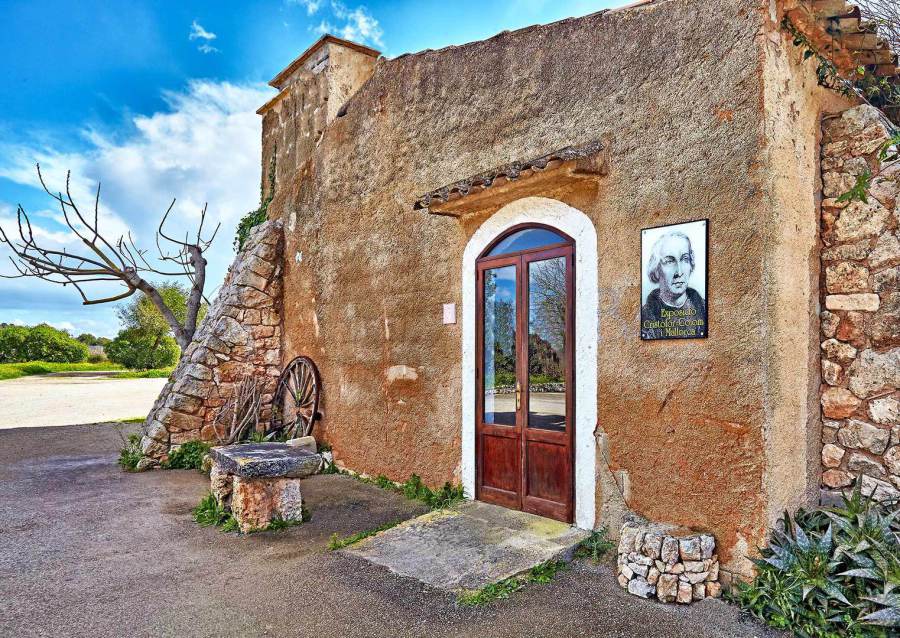
Exposición Permananete Cristobal Colón y Mallorca.
Restaurante Son Colom
Cta. Felanitx Campos, Km 1
Felanitx. Mallorca
Correo electrónico / Email :
gabrielverdmartorell@hotmail.com
Teléfono: +34 871 159 854
Phone: +34 600 36 23 89
HORARIOS DE VISITA
Martes- Sábado: 09hrs-16hrs 19hrs-22hrs
Domingo: 09hrs-16hrs
Tuesday- Saturday: 09am-10pm 19pm-22pm
Sunday : 09am-04pm
Lunes Cerrado
Monday Closed

Asociación Cultural Cristobal Colón · Maribel Martínez ABM Consultores
C/ Fernando el Santo, 24, 1C
Madrid - 28010
Teléfono: 91 010 82 65
Phone: 606 86 9538
maribel.mtez@abmconsultores.com
HORARIOS DE VISITA
De Lunes- Viernes : 10hrs-18hrs
Monday - Friday : 10am-06pm
Dirección Postal
Asociación Cultural Cristobal Colón
Apartado de Correos 8022
07008 Palma de Mallorca
en redes sociales :
 Compartir
 Versión para imprimir